


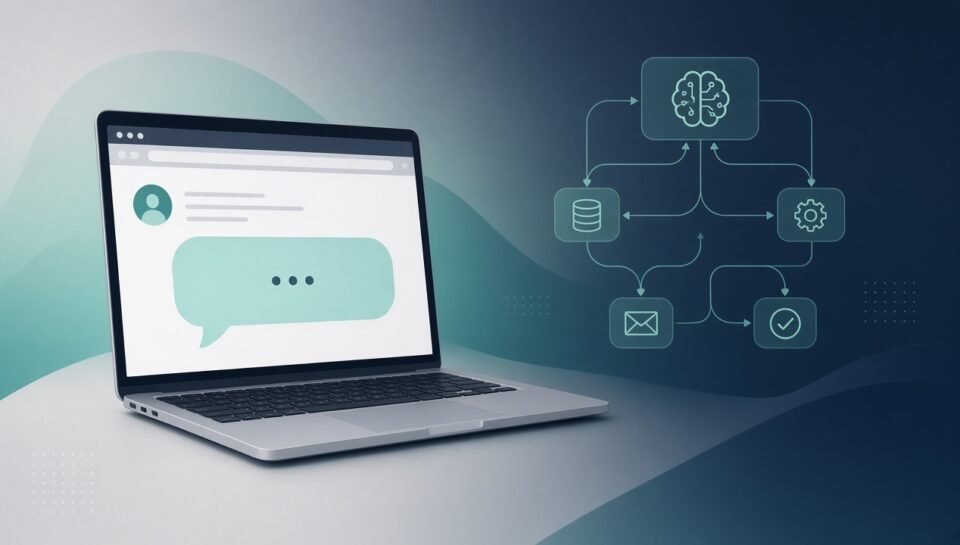
If your team is comparing a “smart chat widget” with a full AI agent, you are not alone. Vendors blur the labels. Buyers in London and Dubai hear “AI agent” when the product only answers FAQs—or “chatbot” when the system can already book meetings and update CRM.
This guide separates conversation from action, so you can invest in the right first layer for your website, support inbox and sales follow-up.
Chatbot vs AI agent in plain English
A website chatbot is built to hold a useful conversation. It understands natural language, retrieves answers from your knowledge base, captures contact details and routes people to the right page or human. Its job ends when the visitor has an answer or a clear next step.
An AI agent is built to finish a job. It can plan steps, call tools and change state in your systems—checking availability, creating a CRM lead, sending a quote draft, pausing a subscription or opening a ticket—within rules you set.
Many 2026 platforms put a chat interface in front of agent capabilities. The UI looks similar; the risk and value live in what happens after the reply.
| Need | Better first fit |
|---|---|
| FAQs, hours, service explanations, bilingual answers | Website chatbot |
| Lead capture + light qualification | Website chatbot (often with CRM webhook) |
| Book a meeting from live calendar slots | AI agent (or chatbot + booking integration) |
| Update CRM stage, create quote, trigger refund under a threshold | AI agent with guardrails |
| High emotion, legal/finance exceptions, VIP accounts | Human handoff with full context |
Credible industry writing in 2026 makes the same split: conversational AI talks; agentic AI acts across backend systems. Layering both usually beats replacing one with the other.
What UK & UAE SMEs actually need from the website
Creative & Co. clients typically want three outcomes from site chat:
- 1. Answer common questions in English (and often Arabic) without waiting for office hours.
- 2. Qualify and capture the enquiry so sales is not chasing empty forms.
- 3. Hand off cleanly when the visitor needs a human—without making them repeat themselves.
That stack is usually chatbot-first. You train on real FAQs, service pages and policies; you connect the form/CRM endpoint; you add a visible “Talk to a person” path and an offline fallback (email, callback, WhatsApp Business).
Move toward agents when the value is in actions that happen every day: booking, order status, appointment changes, lead enrichment, or multi-step follow-up that already lives in your CRM and calendar.
A practical decision tree
Ask these five questions before you buy:
- 1. Is the value in the answer or in the action? Answer → chatbot. Action → agent (or hybrid).
- 2. Which systems must it touch? If CRM, calendar, billing or inventory are required for success, you need tool access and permissions—not just a knowledge base.
- 3. Is the action reversible and rule-bound? Refunds under a limit, address updates and appointment moves are safer agent candidates than one-off commercial exceptions.
- 4. Do you have bilingual or dual-market expectations? UAE and UK visitors often need English + Arabic journeys, local contact norms and clear escalation to a named team.
- 5. Can your team review logs weekly? If nobody will inspect failed tool calls, hallucinations and handoffs, keep autonomy narrow.
If you answered “answer / website / reversible / yes we will review,” start with a governed chatbot and one or two agent actions later. If you already drown in repetitive operational tickets that need system changes, design the agent scope first—but still keep a conversational front door.
Governance that keeps buyers and regulators comfortable
UK GDPR and UAE PDPL both care about purpose, retention and access. Chat and agent systems process personal data: names, phone numbers, message content, sometimes payment or health context.
Minimum controls for SMEs:
- Document what data the bot/agent can see and store.
- Prefer least-privilege API keys and separate staging credentials.
- Log tool calls (who/what/when) for CRM and booking actions.
- Block high-risk actions (large refunds, contract changes, medical advice) without a human.
- Publish a clear privacy notice for chat and keep retention short for raw transcripts unless you have a reason to keep them.
- Test Arabic and English paths separately—tone, escalation phrases and form fields often break in one language only.
For broader integration discipline, see our guide on secure no-code integration governance.
Suggested 30-day rollout for a London or Dubai SME
Week 1 — Scope. List the top 20 website questions and the three actions staff repeat daily. Decide which stay FAQ-only and which deserve tools.
Week 2 — Chatbot live. Launch on AI chatbot integration foundations: knowledge base, lead capture, human handoff, CRM webhook, bilingual copy if needed.
Week 3 — One agent action. Add a single reversible workflow (for example: book a discovery call from calendar availability and write the lead to CRM). Measure completion and error rate.
Week 4 — Tune. Review transcripts, failed tool calls and handoff quality. Expand only where resolution and enquiry quality improve—not where deflection looks good on a vanity dashboard.
Cost and complexity (indicative, not a quote)
Public 2026 buyer guides put lightweight chatbots in a lower setup and monthly band than multi-system agents. Agents need more integration time, clearer permissions and ongoing evaluation. Treat vendor list prices as a starting point; most of the spend for SMEs is configuration, content and change management—not the model alone.
FAQ
Do we need an AI agent if we already have a website chatbot?
Not automatically. Keep the chatbot if it already answers FAQs and captures leads well. Add agent capabilities when you need reliable actions in CRM, calendar or order systems.
Should we replace our chatbot with an agent platform?
Usually no. Use conversation as the front door and agents for a small set of high-volume, reversible tasks behind it.
What about WhatsApp?
Many UK and UAE customers prefer WhatsApp for follow-up. Treat website chat and WhatsApp as channels that should share CRM and handoff rules. For API and CRM wiring, see our WhatsApp Business API + CRM playbook.
How do we measure success?
Track first-contact resolution for FAQs, qualified leads created, booking completion rate, handoff CSAT and repeat contacts—not deflection alone.
Next step
If you want a chatbot that sounds like your brand—and only the agent actions that are safe to automate—Creative & Co. designs bilingual journeys across websites, CRM and follow-up for UK and UAE teams. Explore AI chatbot integration or browse our services to start a practical scoping call.
Sources & further reading
- Shopify, “AI Agent vs. Chatbot Guide for Small Business Owners” (2026): https://www.shopify.com/blog/ai-agent-vs-chatbot
- Fundesk, “Conversational AI vs Agentic AI in Customer Service” (2026): https://www.fundesk.io/conversational-ai-vs-agentic-ai-customer-service
- OptimyCloud, “AI Agent vs Chatbot: Which Solution Should Your SME Choose in 2026?”: https://optimycloud.com/en/blog/agent-ia-vs-chatbot-lequel-choisir-pme.html




